
Water utilities
Track assets, meter readings, billing, and performance. Build the indicators their regulator requires and see where service is failing.
mWater is free, open-access data infrastructure for water and sanitation. Utilities, ministries, and thousands of other organizations use it to map services, collect field data, and run their operations. Since late 2025 we have built AI into that platform. An investment here reaches every organization already using it, not one project in one country.
The platform is free to its users, and no mWater feature has ever moved behind a paywall.

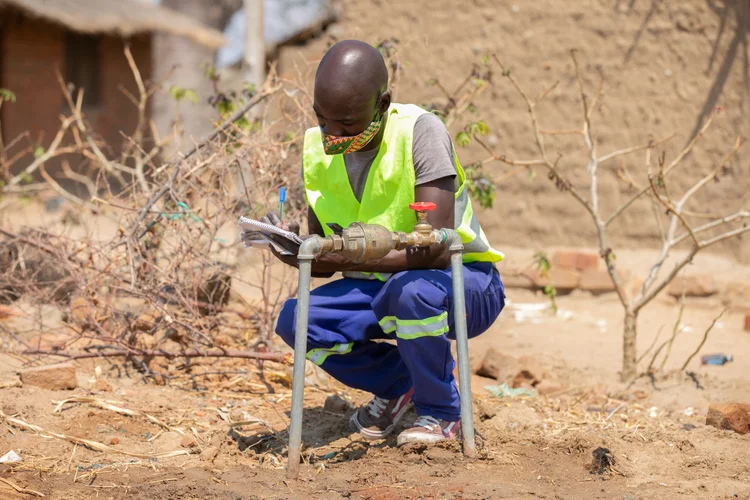
The institutions responsible for water services collect more data than ever. Very few can hire the analysts, GIS specialists, and developers who turn that data into decisions, or afford the license fees of commercial analytics tools.
A district office responsible for thousands of water points may have nobody to clean the records, build the indicator the regulator asks for, or find out why a calculation is wrong. The limit is analytical capacity, not data.
This is the gap our AI features address. They give existing staff a way to do specialist work themselves, inside the system they already use.
Staff clean data, build indicators, query records, and design dashboards in plain language.
Teams answer their own questions without waiting for a consultant or a developer.
Better data quality, faster analysis, and monitoring that local managers actually use.
Funding here extends something proven and widely adopted. The distribution, the data, and the trust are in place, so a new capability reaches users in 198 countries on the day it ships.
operating continuously since, through 14 years of government and NGO use.
countries whose national water and sanitation monitoring runs on the platform.
platform uptime in 2024, on infrastructure teams depend on daily.
languages the platform runs in, so teams work in the language they speak.
of the codebase is open source, with core libraries published on GitHub.
countries and territories where people have already used the AI features.
National monitoring systems have usually arrived through multi-year contracts worth millions of dollars. This one did not.
In March 2026 we delivered a national management information system directly to Zimbabwe's Ministry of Health and Child Care, in about one month.
As Ministry staff gained confidence, their requests moved from branding and structure to district-level sanitation and hygiene analysis, and then to public access to national information.
After we demonstrated the MCP server, the Ministry asked for early access and became its first national-ministry user. Staff now use AI for data cleaning, indicator selection, and faster problem solving.
“Public servants in the countries we serve have spent years solving hard problems with fewer tools. They are proving to be especially creative and eager adopters of AI.”Dr. Annie Feighery, co-founder and CEO
National data becomes usable locally. District teams work with the records that concern them, ownership of the data is clearer, and the Ministry runs the system itself rather than depending on an external contractor.
The system is live at zimbabwemohcc.mwater.co.
Performance metrics, dashboards, and complex calculations used to wait for someone with a data background. Now the person who understands the operation does the work directly.
Teams develop the performance indicators their regulator or board requires, without a data scientist.
Layouts and visualizations can be tried, discarded, and revised in one sitting.
Complex calculations get debugged in minutes instead of being abandoned.
“The AI dashboarding tool has been instrumental in our work at FundiFix. It has allowed me to experiment rapidly with layouts and visualizations, develop key metrics, and troubleshoot complex calculations much faster than I could have done manually.”
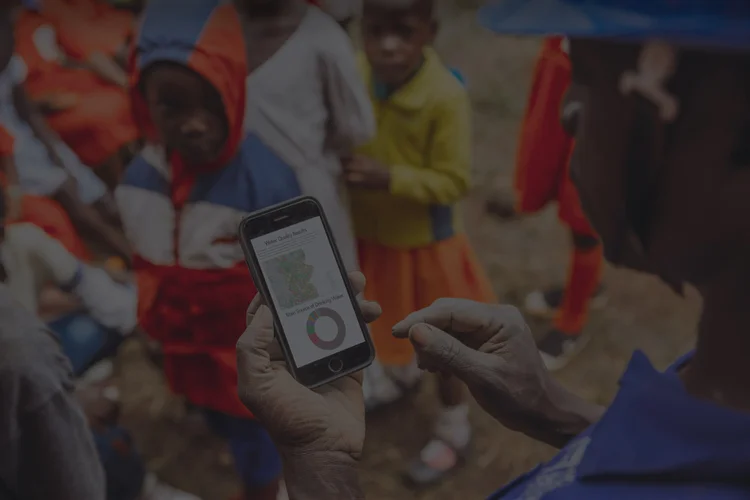
Track assets, meter readings, billing, and performance. Build the indicators their regulator requires and see where service is failing.
Run national and district monitoring, approve field submissions, and publish results. More than 30 national, regional, and local agencies work with us directly.
Collect field data offline, report to funders, and hand working systems to local partners at the end of a program.
Inspect sites, log faults, and follow repairs through to completion, on phones that work without a connection.
These are the kinds of requests users make of the AI features every day. Each one runs against the organization's own mWater data, within the permissions that user already has.
The AI works with the data and organizational structure a team already has in mWater. Nobody has to start again in a new system, migrate their records, or buy a license.
Our AI proposes and people decide. Because the AI lives inside established infrastructure, it inherits fourteen years of access control, audit logging, and data ownership rules rather than inventing new ones.
mWater is a Digital Public Good. It is free to its users, and when a funder pays for a feature we build it and release it to everyone at no cost.
Funding a single bespoke dashboard or database helps one office for as long as the project pays for it. The same money spent on shared infrastructure reaches every organization on the platform, including the 99% of users who have never had a direct engagement with our team.
Our own model costs to date are measured in hundreds of dollars, not millions. The scarce input is engineering time, and that is what funding buys.
mWater Foundation Inc. is a US 501(c)(3) nonprofit. Stellar Data, our commercial subsidiary, sells advanced support and data services and returns all profits to the Foundation.
If you fund AI for development, we would like to walk you through what Zimbabwe's Ministry and utility teams are doing with these features, and discuss what we could build next.
Our thinking is public: the AI strategy, and our product lead on mWater as the backbone of the WASH sector.